By Donna Richardson
There is a particular silence in the Austrian Alps that does not feel empty, but inhabited. It is a silence made of stone, forest, water, and time — something steady enough to hold you if you are willing to be held. The mountains around Leogang do not ask for attention. They simply endure. Ancient, composed, unchanging in a way that makes everything else feel momentary.
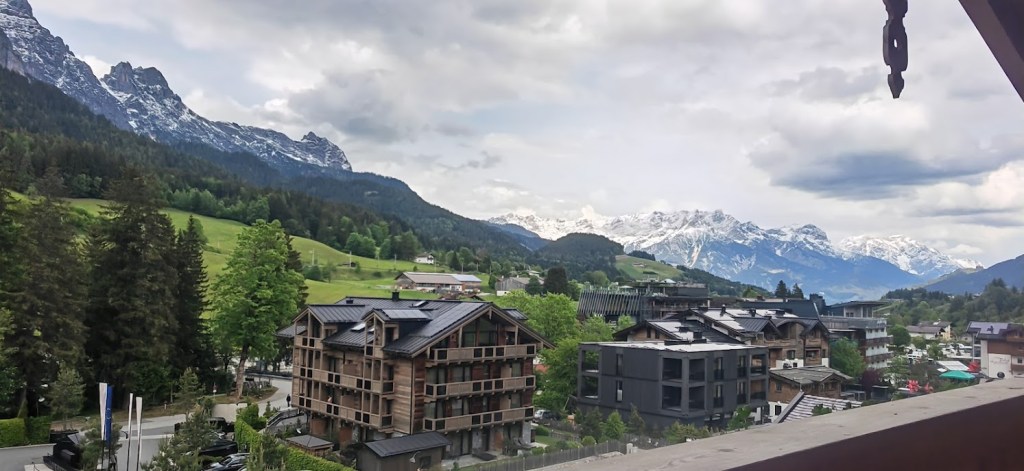
I arrived here already carrying too much to name. In the months leading up to this journey, my nervous system had become overstretched — shaped by sustained work pressure, undiagnosed ADHD, long delays in accessing support for unprocessed trauma, rejection sensitivity, and the quiet accumulation of misunderstandings in both personal and professional life. Layered beneath it all was grief: the recent loss of a close family member to cancer, which reopened something older and more unresolved — the loss of my mother almost twenty years ago. That grief did not return as memory alone, but as something embodied, something still stored in the system.
And then, just days before departure, I was mugged. The experience left me shaken in a way that went beyond fear — it created a kind of internal dislocation, as if my body and mind were no longer moving at the same pace. I remember feeling as though I was trying to catch up with myself.
The journey to Gatwick felt long even before the flight began, softened only slightly by an overnight stay at the Sofitel with a close friend. Sharing the room brought moments of warmth and familiarity, two ADHD minds colliding in sparks of conversation, humour, overstimulation, and energy. It was comforting to be understood without explanation, yet even then, I could feel something inside me fraying beneath the surface.
By the time I reached the airport, I was exhausted beyond capacity. Airports usually carry a certain electricity for me — movement, transition, possibility — but this time everything felt invasive. The fluorescent lights, the rolling announcements, the choreography of trays, belts, shoes, and scanners all became too sharp, too immediate. Even the procedural rhythm of security felt like a stripping away I no longer had the reserves to tolerate. My travelling companion understood the restless, nervous energy moving through me, as a fellow neurospicy, but I was beginning to realise this was no longer adrenaline serving me; it was stress turning inward, attacking my nervous system instead of protecting it.
Then the constant buzz of WhatsApp notifications began, conversations stacking over one another before I had even processed my own thoughts – I blocked them – just get to gate my head screamed. And yet, in the middle of that overwhelm, something unexpected appeared. A school group moved ahead of us through the terminal, full of excitement and chatter, carrying instruments and backpacks with that unmistakable feeling of collective anticipation. I watched them almost from a distance, like a fly on the wall, remembering when travel used to feel like that for me too – filled with excitement, possibility, and uncomplicated joy. Some carried instruments, others folders. I realised that I was witnessing something my nervous system had temporarily lost: the ability to move through space without internal resistance.
We boarded, and we flew. And somewhere over the clouds, there was a pause – a suspension between what had been and what was about to come as I gazed at the mountains and the promises they held.
When we landed in Austria, the shift was immediate but subtle. The air felt different – clearer, slower, more defined. The mountains hugged the horizon and, for a brief moment, I felt something close to freedom. But almost immediately, the noise returned through the sharp mechanics of Schengen entry procedures — passport checks, validation points, queues, instructions, layers of unnecessary bureaucracy that demanded concentration when my nervous system already felt stretched beyond capacity. It was administrative noise masquerading as order, adding stress where there should have been ease. And yet, in the middle of that clutter and procedural chaos, something extraordinary happened. It was the same school group. One voice rose first. Then another. Then a small group gathered itself into sound as they began to sing, and the whole atmosphere changed. Fragments of The Sound of Music, at first, almost playful in their familiarity, brought smiles to the tired travellers’ faces. Then Ave Maria landed somewhere deeper. My breath caught, and I shed a tear, a quiet internal release. It wasn’t sadness alone. It was recognition. Something in me is being met without language, without explanation. A loosening I did not know I needed, and Austria was the place I needed to let go.
Little did I know at the time, but at that moment marked the beginning of something I can only describe as a recalibration.
And underneath all of it was something deeper still: the quiet truth that the body keeps the score. Not as a metaphor, but as a lived reality. Every shock, every grief, every moment of unsafety had already been recorded somewhere beneath language. I had learned to function through it — but not to fully discharge it.
As we travelled deeper into SalzburgerLand, the landscape began to reorganise perception itself. Forests thickened, light softened, and the horizon rose into layers of green and stone. Everything felt slower and more deliberate. I wanted to feel the moment and escape distractions, but my mind was full of nervous energy, and I began chatting to my fellow travellers and trying to create bonds, but I had the opposite effect. Was it my energy?
By the time we reached Leogang, I had settled. This is a place shaped by movement: mountain bikers carving their way up alpine trails, cable cars lifting bodies to altitude, forests that hold both effort and release in equal measure. It is a landscape that invites participation rather than observation.
And yet, it was Naturhotel Forsthofgut that became the emotional centre of the experience.
From the moment of arrival, the tone shifts. Naturhotel Forsthofgut is not a hotel that processes guests; it is a hotel that receives them. At arrival, guests are offered cold towels — simple, refreshing, grounding — a sensory reset after travel. Bags are taken without friction, and there is a gentle invitation inward: your luggage disappears quietly into care, and you are invited to go up to your room as if the building already understands your need to arrive slowly.
A handwritten welcome board stands at the entrance. Fresh flowers sit throughout the lobby. Nothing feels staged — everything feels intentional in its restraint.
In the lobby, a beauty drink is waiting – cool, bright, antioxidant-rich. It is not just hospitality; it feels like a signal to the nervous system that something is beginning to settle.
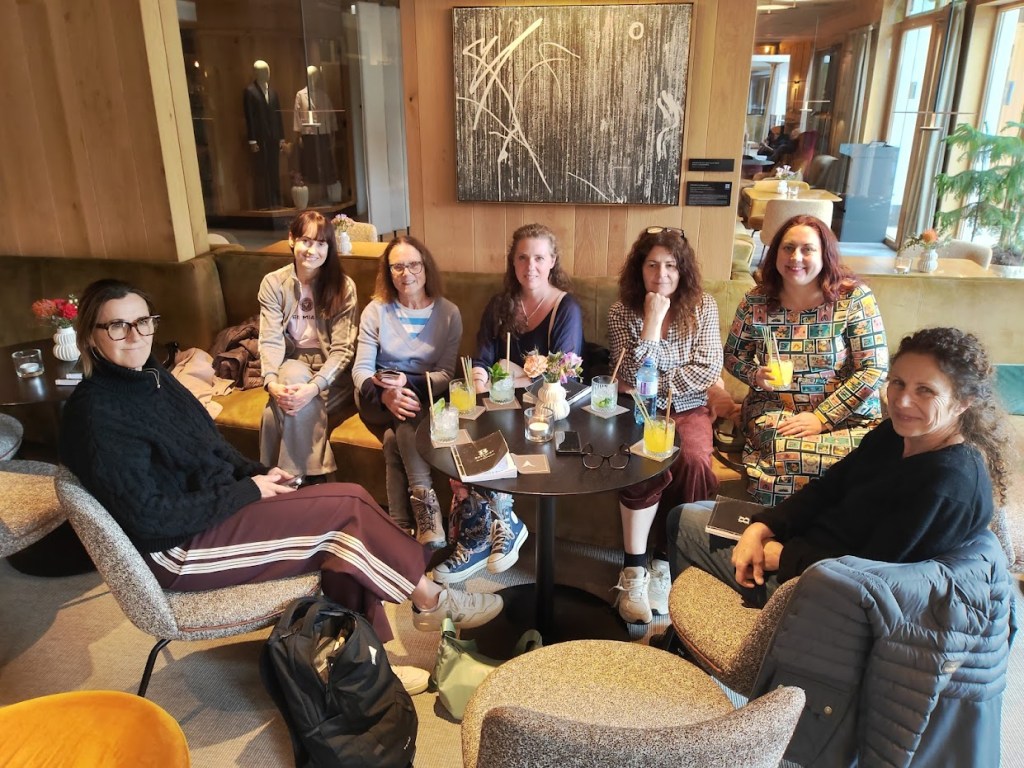
From there, guests are invited into late afternoon tea — a ritual that dissolves the idea of “in-between time.” Herbal infusions, alpine blends, chamomile, Earl Grey, and fruit teas are offered not as choice overload but as gentle grounding. It becomes a pause that teaches the body to slow down again.
Set at the foot of the Asitz mountain, the hotel is shaped by continuity rather than concept. The Smuck family, who have cared for this land across generations, have evolved it from forestry and agriculture into a five-star hotel where hospitality, landscape, and wellbeing remain expressions of the same relationship to place. Their presence is felt in everything, but never imposed, with a quiet integrity rooted in care, humility, and stewardship. A handwritten welcome note reinforces this immediately: personal, unpolished, human — not branding, but attention. On arrival, a family reception including the younger generation added a rare sense of intimacy and continuity.
Originating from a forestry and farming estate established in 1617, the Smucks have transformed Forsthofgut into a leading nature-led retreat while staying deeply anchored in their origins. Christoph and Christina Smuck continue to guide it with a philosophy of stewardship over reinvention, while their children represent the next chapter — growing up within a living legacy where nature, responsibility, and hospitality are everyday values passed forward through generations.
The Room as a Landing Point
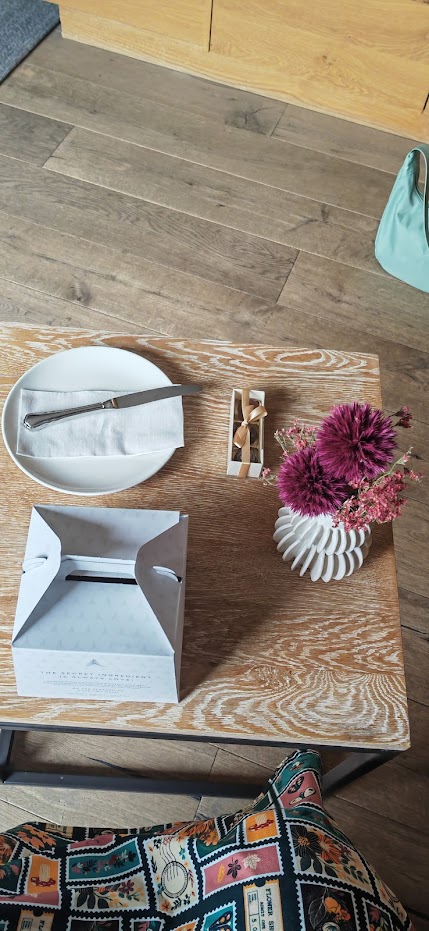
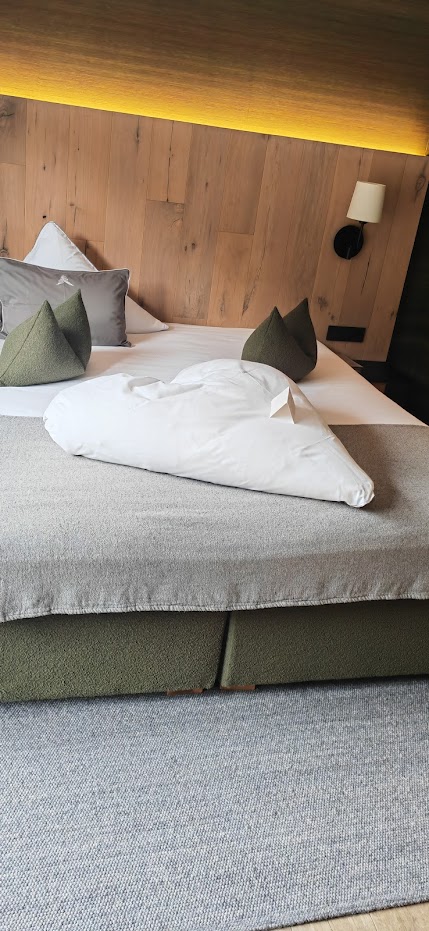
The room does not arrive as a space you enter, but as a soft landing you are already being guided into long before you reach it. Your bags are taken ahead of you and quietly placed inside, so there is no waiting, no friction, only a gradual easing upward into stillness. The door opens into warmth and light rather than instruction: the scent of wood and linen, the softness of natural textures, the hush of air that feels gently held. Light spills across a balcony framing the mountains as if they have always been there, waiting. Slippers are already placed by the bed, towels folded with quiet precision, linen shaped into soft sculptural forms. A warm Bundt cake rests on the table, alongside small rituals of care – sleep spray, eye mask, pulse roller – each one suggesting rest without demanding it. Nothing in the room asks anything of you. Instead, it feels as though the space is breathing with you, allowing your nervous system to downshift without instruction, until even standing still feels like enough.
Dining as a Rhythm of Restoration
Food at Forsthofgut is not confined to one restaurant or moment – it is a continuous thread woven through the day, each experience offering a different emotional temperature.
Breakfast at the Market Place is like a living buffet of nourishment, designed to rebuild with fresh juices, eggs, grains, salads, breads, alpine cheeses, and protein-rich options that sit alongside lighter, restorative choices. It is food that supports both energy and recovery, depending on what the body asks for. You can also order the special or Eggs Benedict from the menu.
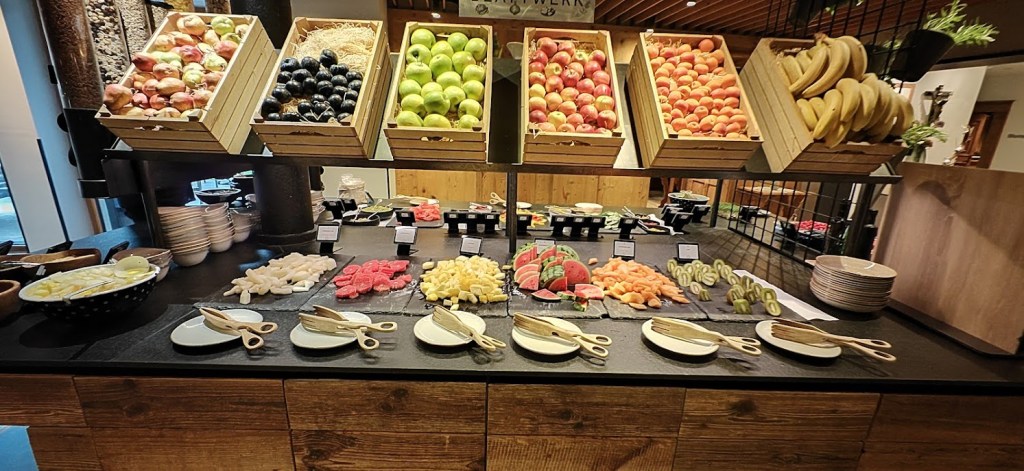
Lunch by the spa carries a lighter expression – fresh, simple, aligned with the rhythm of water and forest rather than indulgence for its own sake. By evening, the hotel opens into layered dining atmospheres. The wine list is extensive and expressive, designed not as excess but as conversation — something to be explored slowly, alongside food that remains rooted in nourishment and place.
Each dining moment feels like a different form of return: energy, pleasure, grounding, or stillness. When it comes to fine dining, silva offers an immersive culinary destination where nature, imagination, and exceptional gastronomy come together in extraordinary fashion.
With only 10 seats available each evening, the experience feels deeply personal — an invitation into a hidden world shaped by the beauty and mystery of the surrounding alpine forest.
Led by head chef Michael Helfrich, alongside Johann Koller and pastry chef Birgit Tüchi, the evening unfolds like a modern fairy tale. Together, the trio create a sensory tasting journey inspired by the rhythms, textures, and flavours of the woodland. Every course is thoughtfully designed to reflect the forest itself – from wild herbs and seasonal alpine ingredients to smoky aromas, earthy notes, and beautifully artistic presentation.
The atmosphere is just as captivating as the cuisine. Soft lighting, natural materials, and cinematic attention to detail transport guests into a dreamlike setting where every element feels intentional. As each course arrives, storytelling and gastronomy intertwine, turning dinner into an emotional and unforgettable experience rather than simply a meal.
Here, dining becomes something magical, intimate, immersive, and deeply connected to nature. A place where fantasy meets flavour, and where the forest inspires every moment from beginning to end in a theatrical way and such love and care that you leave emotionally restored.
Art, Atmosphere and the Quiet Curation of Beauty
Forsthofgut is expansive in a way that never feels overwhelming, but instead gently unfolding – a place designed to be explored slowly, intuitively, almost like a landscape in itself.
With 121 rooms and luxurious suites, the hotel strikes a balance between intimacy and scale. Some of the most exclusive suites reach around €3,000 per night, with every luxury including a private sauna and Christian Doir gym equipment and Alpine views to die for – and there’s also the lofts where many famous celebs retreat. It is pure luxury – yet there is no sense of separation or hierarchy in how the space feels. Everything is held within the same philosophy of care, attention, and quiet luxury.
As you move through the buildings, the design subtly shifts among natural materials, open light, and framed views of the mountains beyond. Corridors open into quiet lounges, spa pathways lead toward water and forest, and every transition feels intentional – never rushed, never forced.
What stands out most is how the hotel encourages orientation not through signage or structure, but through feeling. You begin to understand it through atmosphere: where light falls, where silence gathers, where warmth is held.
Even within its scale, there is a sense of containment – as if the hotel, like the mountains beyond it, knows how to hold people without overwhelming them.
Art moves quietly through Naturhotel Forsthofgut like another element of the landscape — woven into corridors, lounges, spa spaces, and moments of stillness. Works by artists including Anselm Kiefer, Martha Jungwirth, and Sylvie Fleury feel less like decoration and more like atmosphere, extending the emotional language of the mountains themselves.
Their works bring different emotional registers into the hotel, tension and humour, abstraction and memory, materiality and gesture from a deeply moving abstact mountain painting to works of art made out of old cassette tapes yet together they form a coherent visual language rooted in transformation, nature, and perception. Nothing demands attention; everything deepens it.
Art here is not separate from the alpine environment; it belongs to it as another form of landscape, another way of seeing the same world.
Sauna Rituals, Water, and the Body in Transition
The spa experience extends into something more elemental in the sauna world, where heat, silence, and contrast bathing create a rhythm that is both ancient and precise. Moving between sauna rituals, cold plunges, and quiet rest spaces becomes a dialogue with the body itself — a cycle of tension, release, and return. There are textile areas, where the body is held in soft coverings, and non-textile zones, where vulnerability meets openness in a more exposed way. At first, there is a subtle internal hesitation — a consciousness of body, of comparison, of visibility – and yet over time, something shifts. Not into certainty, but into acceptance. Into observation without judgement. Into the possibility that comfort with one’s body in nature is not immediate, but gradual. And within that gradual unfolding, there is space for a different future version of ease — one where freedom is not forced, but gently arrived at.
The Body, the Landscape, and Release
One of the most grounding experiences was horse riding at the stables. The warmth of the horse, the rhythm of movement, the necessity of trust – everything brought me fully into the present moment. Meeting Saphir, the horse, was one of the most grounding moments of the experience. She carried a calm, steady presence, but also an intelligence that was immediately apparent — she had a mind of her own. There was nothing submissive or overly obedient about her energy. She moved with autonomy, presence, and quiet confidence, and I found myself respecting that instantly.
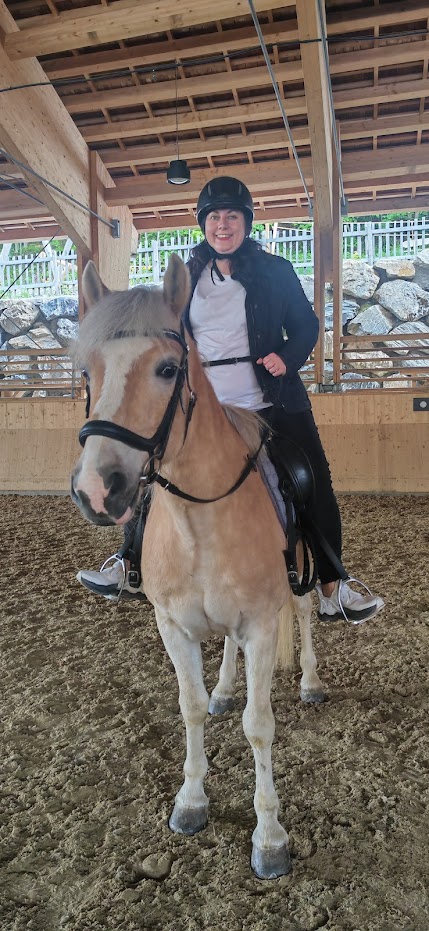
As I got closer, the stable air was layered with the scent of hay – warm, earthy, slightly sweet mixed with leather, wood, and the soft animal warmth that belongs only to places like this. It was an atmosphere that felt honest and unpolished, alive in a very natural way.
Outside, the alpine air moved through the stables and out across the landscape, whipping my hair and heightening everything at once. There was a sharpness to it – fresh, cold, alive and with it came a surge of adrenaline, not anxious, but awakening. A reminder of being fully in my body, fully awake to the moment.
There was something in Saphir’s nature that I recognised in myself – not to be tamed, not to be forced into compliance, but to move with instinct, awareness, and inner direction. That recognition created an immediate sense of connection between us. As I prepared to ride, something subtle shifted. It was no longer about anticipation or thought, but about relationship. The bond with her built quietly, through touch, through breath, through the shared stillness before movement.
Once in motion, there was a deep sense of presence – mine and hers. The rhythm of her steps, the landscape opening around us, the wind against my skin. It felt like trust without words, a shared understanding carried through movement rather than instruction.
In that space, I wasn’t observing the experience – I was inside it. Grounded, alert, and entirely present with her. Hiking with guide Klaus added another layer of grounding. The path itself moved between challenge and beauty. Steeper sections asked for effort, breath, and focus, while open stretches revealed wide alpine views that softened everything at once. The group naturally found its own rhythm, moving together without needing to coordinate it, as if the landscape was setting the pace rather than us.
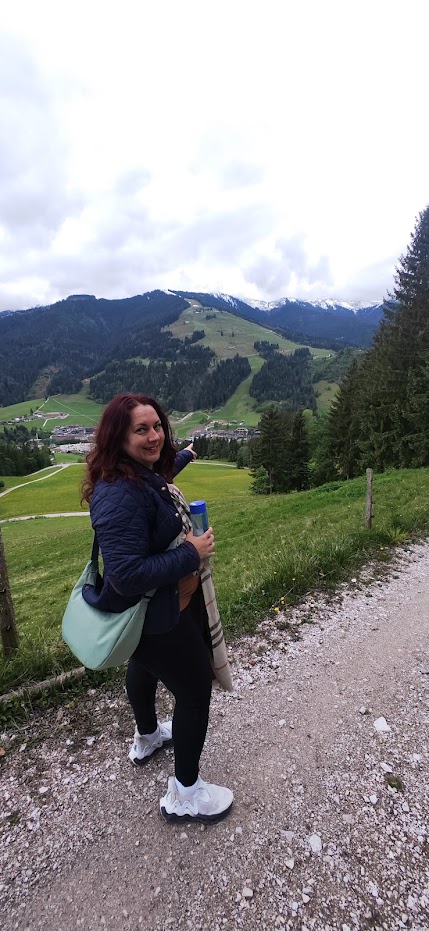
With Klaus, conversation came in fragments rather than structure. He spoke lightly about his time in the Algarve as a golf instructor, and about winters spent skiing in the mountains. These details didn’t feel like stories being performed, but lived experience shared casually between steps, shaped by movement rather than pause.
As the climb continued, something in the body began to regulate. The nervous system shifted through effort into balance – breath deepening, mind quietening, attention narrowing to footfall, air, and incline.
When we reached the top, there was no sense of triumph or performance. It was something softer than that – a collective exhale. A release that arrived not through achievement, but through arrival.
In that moment, the body felt recalibrated by nature itself. Present, steady, and quietly restored.
The walk was challenging, but what stayed with me was not difficulty – it was togetherness. As a group, we moved without pressure or performance. There was permission to simply be in it.
Klaus guided with calm steadiness, sharing fragments of his lifetime in the Algarve as a golf instructor, winters skiing in the mountains.
When we reached the top, it wasn’t triumph – it was release. A soft internal loosening.
Let yourself feel lighter with cocktails by the pool at sunset, where water reflects changing sky, and drinks at the bar where Tom, the head bartender, creates with intuitive precision, responding to mood as much as request, and he made me some of his signature libations.
And there are quieter rituals too – tea by the fire, wrapped in warmth and stillness, where nothing is required except presence or a full-on spa ritual where you can surrender yourself to the elements and forget about your inhibitions.
WALDSPA and Natural Medical Integration
Nature is deeply healing here, but the WALDSPA also brings a different dimension — a bridge between instinctive restoration and medical precision. Alongside forest stillness and water, there are therapies such as cryotherapy, IHHT hypoxia training, and the uVIDA metabolic system.
What matters is how it exists inside nature rather than replacing it. You move between forest air and clinical clarity, between instinct and data – and both belong.
Spa Atmosphere, Stillness and Everyday Luxury
Just walking through the spa becomes part of the experience itself. There is a softness in simply moving between spaces — the sound of water in the background, light shifting through glass, the quiet rhythm of people slowing down without needing to explain why.
Sunning yourself by the pool becomes its own form of rest, as does floating in the infinity water where the boundary between body and landscape feels almost dissolved. There is no urgency to do anything else – just being held by warmth, water, and mountain air.
And then there are the in-between moments that anchor the day in quiet pleasure. A cocktail overlooking the spa, watching light move across water as the day softens into evening. A cup of tea by the fireplace, wrapped in stillness and warmth, where time feels suspended rather than measured.
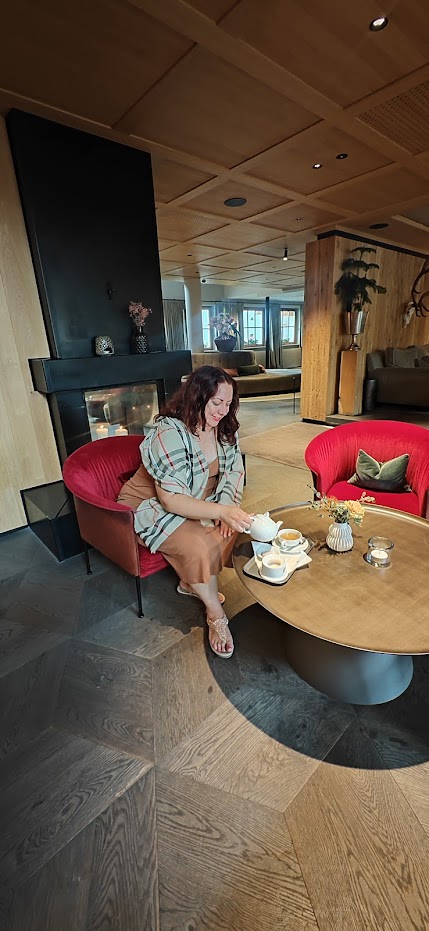
In these spaces, inspiration is everywhere – in the architecture, the water, the silence, and especially in the art that threads through the hotel, gently shaping mood without demanding attention.
Even the bar becomes part of this rhythm. Tom, the bartender, creates cocktails with a kind of intuitive craft that feels considered and personal – drinks that carry both precision and creativity, matching the atmosphere rather than competing with it.
Everything here feels interconnected: rest, beauty, taste, and light. Nothing is separate. Nothing is rushed. It is a place where even the smallest moments – sitting, sipping, looking – become part of the experience of returning to yourself.
Textile and Non-Textile Spa Spaces
The spa moves across both textile and non-textile areas, yet nothing about it feels forced or prescriptive. It is not about rules – it is about choice. In both spaces, the same philosophy holds: nothing is staged, nothing is expected. You are simply allowed to be yourself. And in that permission, the body begins to soften – not because it is told to, but because it finally feels safe enough to.
Spa, Water and Nervous System Reset
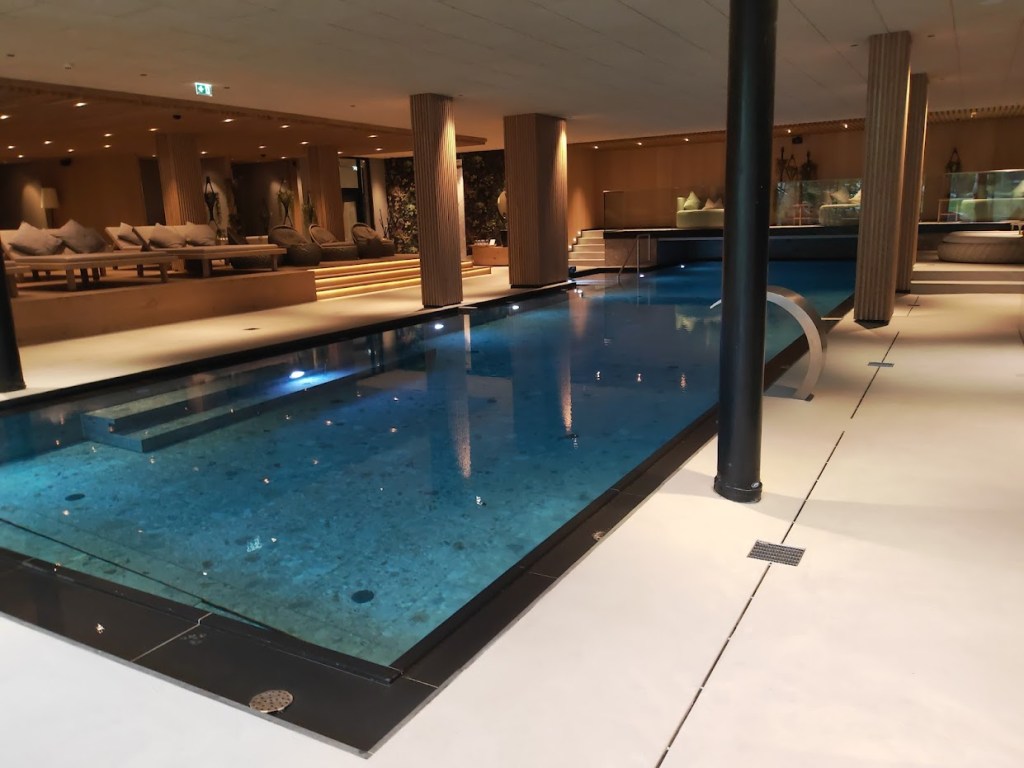
The spa at Forsthofgut moves with nature rather than against it. Water becomes the central language of return – still pools, warm immersion, cold exposure, steam rising into alpine air. Just walking through the spa becomes part of the experience itself. There is a softness in simply moving between spaces — water sounds, shifting light, and silence that does not demand explanation.
On the rooftop pool, rain fell into still water, each drop expanding into endless rings. Time felt layered, almost liquid. And I felt fully inside it.
Sunning yourself by the pool, or floating in the infinity water, brings a sense of release – as if the body is being held by both water and mountain at once. A cocktail overlooking the spa, a tea by the fireplace, or simply sitting with the art and architecture becomes part of the same rhythm. Inspiration is everywhere, not staged, just present.
Even the smallest details feel considered. Tom, the bartender, creates cocktails with intuitive precision – drinks that match the atmosphere rather than compete with it.
Massage and Release
The massage was also deeply needed. My male therapist worked into the knots with an intuitive strength and precision that felt genuinely therapeutic rather than superficial. There was a sense of experience in the way he approached the body -not just easing tension, but meeting it where it had been held for too long. It was firm, at times intense, but always purposeful, as if he understood exactly where the body had been compensating and bracing. Layer by layer, something was released that I hadn’t fully realised I was still carrying. Afterwards, there was a noticeable shift – not just physically, but internally. A quiet sense of space is returning to areas that had felt compressed for a long time.
Horse riding with Saphir, hiking with Klaus, the spa, the water, the forest – all of it becomes part of the same recalibration. And underneath it all, one truth continues to surface: the body keeps the score and every lived experience positive and negative remains in your body..
Resilience and Listening to the Body
Resilience is something I have built carefully over time – not as armour, but as necessity. But the body remembers everything the mind tries to organise away. The uVIDA system offered a mirror – translating physiology into understanding of my own body and its DNA. Across everything – movement, water, silence, nourishment, landscape – a thread persists. Not transformation. Recognition. A gradual unravelling of what was held too tightly for too long. The mountains remain steady. unmoving and present and in their presence, something in me remembers how to be inside myself again. The mountains did not cure me. They held me until I could hold myself again.
 Donna Richardson Travel Journalist
Leave a comment